

When you're shopping for a home in Arizona, especially from another state, price per square foot feels like the easiest way to compare. Divide the price by the size, and you have one simple number to line up against every other listing.
It's a useful starting point. But on its own, it can lead you to the wrong conclusion about whether a home is a good value, or what your current home is worth.
Two ideas explain why: price compression, and the difference between single-story and two-story homes. Both matter a great deal here in the Valley, and both are a big part of why I calculate value neighborhood by neighborhood rather than relying on a citywide average.
What Is Price Compression?
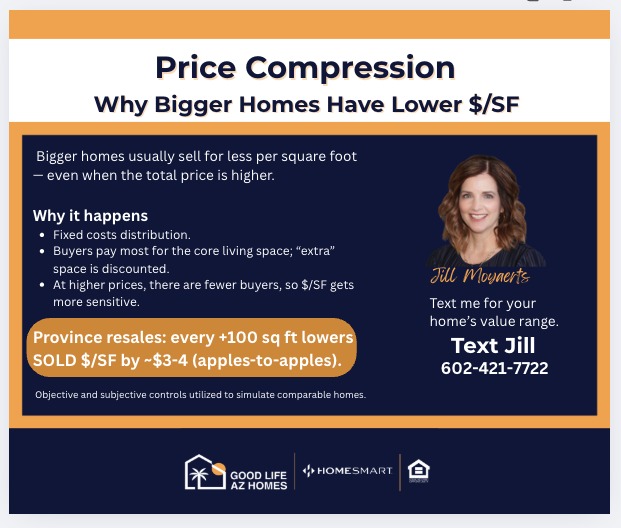
Price compression is the tendency for home prices in the same neighborhood to cluster closer together than their sizes would suggest. As homes get larger, the price usually goes up, but not at the same rate. So larger homes tend to sell for less per square foot, and smaller homes for more per square foot.
Here's a simple illustration (round numbers for explanation only, not actual sales data):
Home A: 1,600 square feet, sells for $480,000, or $300 per square foot
Home B: 2,400 square feet, sells for $600,000, or $250 per square foot
Home B is 50% larger, but it didn't sell for 50% more. Why?
Some of a home's value doesn't grow with its size. Every home has a lot, a location, a kitchen, a roof, and major systems. Those make up a big share of the price, whether the home is 1,600 or 2,400 square feet. In a larger home, that value is spread over more square feet.
Buyers pay for the neighborhood first. Most buyers shop within a price range for a community. That creates a natural ceiling: a larger or more upgraded home can only rise so far above its neighbors before buyers look elsewhere.
Extra square footage has diminishing returns. A third guest room or a bonus room adds value, but usually not as much per foot as the core living space.
This isn't just theory. In my own analysis of 2025 ARMLS resale data for Province, the 55+ community in Maricopa, each additional 100 square feet lowered the sold price per square foot by approximately $3 to $4. That's after adjusting for differences like lot location and upgrades, so the homes were compared as closely as possible.
What this means in practice: A larger home that looks "cheaper per square foot" isn't automatically the better deal. And a smaller home that looks expensive per square foot may be priced exactly right for its neighborhood.
Single-Story vs. Two-Story: Why They Price Differently
In most Valley neighborhoods, single-story homes sell for a higher price per square foot than two-story homes of similar age and quality. A few reasons:
Two-story homes stack their square footage. More living space sits on a smaller foundation and under a smaller roof, so the land and structure are spread across more square feet. Two-story homes are also often larger overall, which brings price compression into play.
Single-story homes are in steady demand. No stairs appeals to a wide range of buyers: retirees, people planning to age in place, families with young children, and anyone who simply prefers everything on one level. In Arizona, some buyers also find an upstairs harder to keep comfortable in the summer heat.
Single-story homes use more of the lot. A larger footprint means more land under the home, and land is a meaningful part of value.
So if you compare a single-story home's price per square foot to a two-story home's, you're not comparing like with like. The single-story will almost always look "more expensive," even when both are priced fairly.
Why this matters for 55+ buyers and downsizers
Most homes in the Valley's 55+ communities are single-story, so comparisons within one community are usually cleaner. The confusion tends to come up in two situations:
Selling a two-story to downsize. If you're selling a two-story family home, it may not bring the same price per square foot as the single-story homes nearby, even when it's larger.
Comparing a 55+ community to a mixed neighborhood. If you're weighing a home in a 55+ community against one in a neighborhood like Ahwatukee, Chandler, or Gilbert, where single- and two-story homes sit side by side, a neighborhood average can blend the two and give you a misleading number.
Why Price per Square Foot Has to Be Calculated by Area
There's no single "Phoenix price per square foot" that tells you much. Values vary widely between cities like Scottsdale and Maricopa, between neighborhoods in the same city, and even between sections of the same community built in different phases or by different builders.
Online estimates often average across a wide area and mix very different homes together. That's why a figure you see on a home search site may not match what a home actually sells for.
How I calculate it
When I evaluate a home for a buyer or seller, I narrow the comparison down to homes that are truly similar:
Same community or neighborhood. Ideally the same subdivision, or even the same phase.
Same number of stories. Single-story homes are compared with single-story homes, two-story with two-story.
Similar size and age. A similar square-footage range keeps price compression from skewing the numbers.
Recent sales. I look at homes that actually sold within the last six months to a year, not asking prices.
Adjustments for what's different. Then I adjust for upgrades, condition, and lot location, such as a golf course or mountain view, a cul-de-sac, a pool, or a lot that backs to a busy road.
The result is a price per square foot that reflects that specific home in that specific place, which is far more reliable than a broad average.
What This Means for You
If you're buying:
Use price per square foot as a starting point, not a verdict.
Compare homes of similar size, and single-story to single-story.
Expect a single-story home to cost more per square foot than a two-story nearby. That's normal, not overpricing.
Don't assume a larger home is the better value just because its price per square foot is lower.
If you're selling:
Your home's value is based on truly comparable recent sales in your area, not a citywide average or an online estimate.
If you're selling a two-story to move into a single-story, plan for the difference in price per square foot on both sides of the move.
Upgrades add value, but price compression means they rarely return more than your neighborhood will support.
Wondering What a Home Is Really Worth?
Whether you're considering a home in a specific 55+ community or thinking about selling your current home, I'm happy to look at recent comparable sales with you and explain what the numbers mean for your situation. Send me a message anytime.
Disclaimer: This article is for general informational purposes only and is not an appraisal or a guarantee of value. The Home A and Home B figures are simplified illustrations, not actual sales data. The Province figure is an approximation from my own analysis of 2025 ARMLS sales and may not apply to other communities or future market conditions. Home values depend on many factors, including location, condition, lot, upgrades, and current market conditions, and vary by neighborhood and over time. For a value estimate on a specific property, please consult a licensed real estate professional or a certified appraiser. Jill Moyaerts, REALTOR®, Good Life AZ Homes, brokered by HomeSmart.